
Promoting Windows 2012 Server to Domain Controller

To create a new AD forest called “ArabITPro.local”, select add a new forest.
Type the name ArabITPro.local
Specify the FFL, DFL, whether or not it should be a DNS Server and also the DSRM administrator password. As you can see, it has selected the GC option by default and you cannot deselect it. The reason for this is that is the very first DC of the AD forest and at least one needs to be a GC.
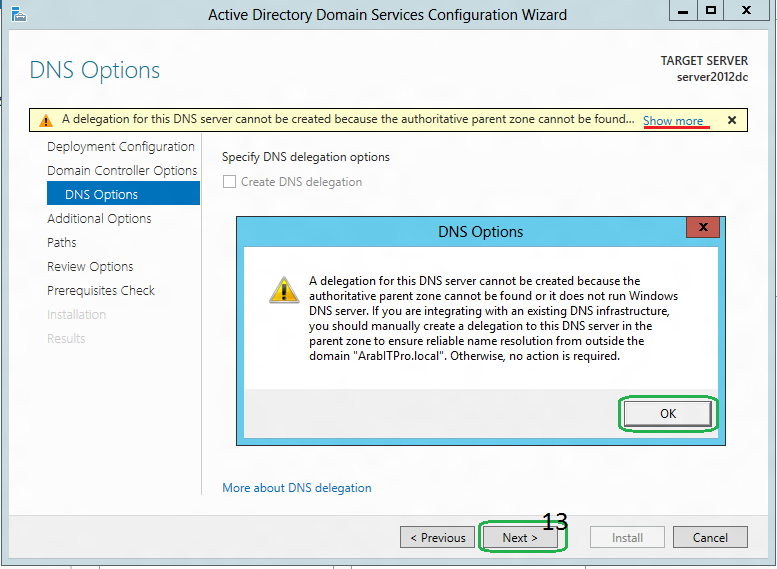
DNS delegation warning.
Checks the NetBIOS name already assigned.
Specify the location of the AD related folders and then click next.
Summary Of All Installation Options/Selections.
Click View script for single command  line PowerShell script for dcpromo.
Before the actual install of AD, all prerequisites are checked. If All prerequisite checks are passed successfully then click Install.
When you click Install, DNS and the GPMC are installed automatically.
After the promotion of the server to a DC finished server restart automatically.
Once the server is booted and you logon to it, click on  Server Manager | Tools ,  will notice that following have been installed :
•Active Directory Administrative Center
•Active Directory Domains and Trusts
•Active Directory Module for Windows PowerShell
•Active Directory Sites and Services
•Active Directory Users and Computers
•ADSI Edit
•DNS
•Group Policy Management

Comments

Popular posts from this blog

Use Portable VirtualBox to Take Virtual Machines With You Everywhere

Install Portable VirtualBox to an External Drive First, get started by downloading the Portable VirtualBox installer from vbox.me . Run the downloaded file and extract it to an external drive or wherever else you want to store your portable VirtualBox system. You can always move it later, if you like. Launch the Portable-VirtualBox.exe program from here and you’ll be prompted to download and install VirtualBox’s program files on your external drive. The tool can automatically download VirtualBox’s files for you. After it does, click the OK button to unpack them. If the full version of VirtualBox is already installed on your computer, you won’t see this screen and VirtualBox will just open instead. You’ll want to uninstall VirtualBox first or set this up on a computer without VirtualBox installed. Launch the program again after it finishes unpacking files. After you agree to a UAC prompt , you’ll see the standard VirtualBox window. A VirtualBox system tray icon...

Tiny 11 - A Lightweight Windows 11 that can run on 2GB RAM and requires less harddisk space.

  In terms of Windows 11, its   system requirements   are high since this system requires at least 4GB RAM, 64GB storage space, enabled TPM & Secure Boot, a high CPU (1 GHz or faster with 2 or more cores on a compatible 64-bit processor), etc. compared to any old Windows operating systems. If you have an old or lower-end PC, Windows 11 is not a good option to install since many issues like random crashes, blue screen errors, etc. could appear on the unsupported hardware. Overview of Tiny11 If you want to run Windows 11 on your old computer with low RAM and disk space, Tiny11 appears in public. It is a project from NTDev and Tiny11 is a Windows 11 tiny edition. This edition is based on Windows 11 Pro 22H2 and includes everything you need for a comfortable computing experience since this tool doesn’t have the bloat and clutter of a standard Windows installation. Tiny11 Requirements In terms of Tiny11 requirements, a scant 8GB of storage and just 2GB of RAM are requ...

Create a Restore Point for Windows 7 or Vista’s System Restore

If you are thinking of installing an application but aren’t quite sure what it’s going to do to your computer, I would absolutely recommend creating a restore point before you install that application, and here are the steps to do so. Note that most application installs automatically create a restore point, but you can do this if you are really worried. Open up the Start Menu and right-click on “Computer”, and then select “Properties”. This will take you into the System area of Control Panel. Click on the “System Protection” link on the left hand side. Now select the “System Protection” tab to get to the System Restore section. Click the “Create” button to create a new restore point. You’ll be prompted for a name, and you might want to give it a useful name that you’ll be able to easily identify later. Click the Create button, and then the system will create the restore point. When it’s all finished, you’ll get a message saying it’s completed successf...